






Jump to: navigation, search
Welcome to the Wikimedia UK Blog
Wikimedia UK: Supporting free and open knowledge

Glasgow/1 Wikimedia meetup

May 22nd, 2013 by Katie Chan

This post was written by Graeme Arnott (User:Oswin Oswald) and originally published here

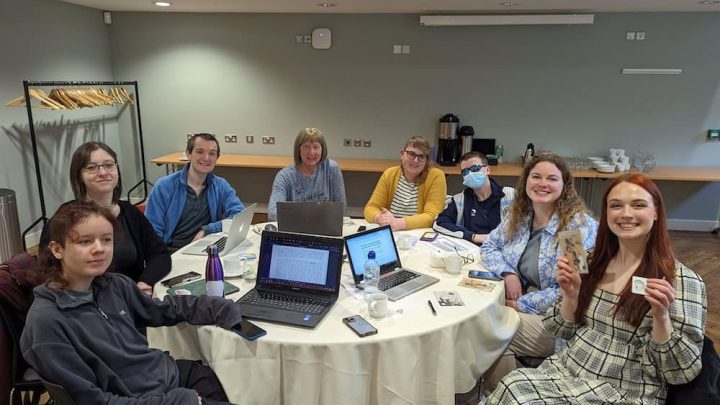
Attendees of the first ever Glasgow Meetup on Sunday 12 May 2013.

Attendees of the first ever Glasgow Meetup on Sunday 12 May 2013.

I’ve done a little bit of editing on Wikipedia but not much. I don’t really have much confidence on it but I’ve now got a new user name I now feel better about contributing on a regular basis. (I was using my own name which increased the pressure not to publicly mess up). I’m going to do the P2P University’s School of Open course ‘Writing Wikipedia Articles: The Basics and Beyond‘ when it starts in July (for European times).

Anyway, getting back to the story. Whilst assembling the material for the TMA presentation I happened to find out that the very first Wikimedia meet up in Glasgow was taking place a fortnight or so before the TMA’s hand-in date, and this was too good an opportunity to miss. Eleven of us met in the Sir John Moore pub on Argyle Street on 12th May and I think it went really well, although you wouldn’t know it from my expression in this picture :-) .

It transpired that the pub’s name was not insignificant. Dan and Julia looked up Wikipedia to get some background on Sir John Moore and found out that he was a Glaswegian who had first seen action for the British Army in the American War of Independence. One of his postings in the 1790s was to the West Indies under a certain Sir Ralph Abercromby. Now, bizarrely the Sir Ralph Abercromby is the pub where Wikimedia hold their meetups in Manchester. How odd is that? Was there then some strange hand guiding the choice of these pubs? If so, what was the pattern and what did it signify? Were these pubs in these similar ex-industrial cities effectively hyperlinked in a way reminiscent of psychogeographic ley lines? Were we like the people on Borges’ map only now were we living on a Wikipedia article? Was the fact that Wikimedia held their meetups on the territory of these one time opponents of liberation a tongue-in-cheek comment on web freedom? Perhaps the solution lay with a certain Richard John Blackler the gentleman after whom the Wetherspoon’s pub is named and where the Liverpool Wikimedia meetups are held. Would he also be a representative of the imperialist redcoats?

Wikimedia in Scotland

Wikimedia in Scotland

The truth in the end was rather prosaic, and a different sort of coat altogether. It transpired that Blacker is remembered for having once owned a department store in Liverpool, and so it turned out there was no mysterious hand at play after all. (This probably means in the future there will be a pub called the Sir Philip Green, although it won’t, of course, be owned by him). Even so, having read how exciting a Wikimedia meetup can be, can you possibly afford to stay away next time?

Seriously, I did actually enjoy the afternoon. Sometimes the admin talk was a little over my head but not alienatingly so, and people mingled and there certainly were no awkward group silences. For a first meeting I thought that we quickly built up a friendly welcoming atmosphere. I’m not sure that I know everyone’s name but we’re starting to think about Glasgow/2 in a couple of months so hopefully we can do it again, and build the group up a bit.

So, it was a good turn out for a first meeting and we can only hope and try to build on that. However it was noticeable that although Katie was there from Wikimedia in London, and Julia had travelled up from Manchester, there were no Glaswegian wiki women. Apparently though this is not something unusual and it seems like Wikipedia has a gender problem. (This will be another post at a later date. At the moment I don’t want to run the risk of parallel essay writing for the TMA). When I read about this edit-a-thon in the Biblioteca Salaborsa in Bologna I had the idea of doing something similar with the Women’s Library in Glasgow.

The library is currently in the process of moving to Bridgeton so this might not be possible until later and depending upon what stage the move is at. A successful edit-a-thon could achieve a number of goals, such as

  • an increase in women in Glasgow editing Wikipedia
  • an increase in articles about Glaswegian women
  • an improvement in the digital skills of Glaswegian women

Thinking ahead, it would be great if the Library could access funding to roll something like this out to the community libraries in Glasgow, and the suburbs of East Renfrewshire and South Lanarkshire.

Maybe this is something we could discuss at the next meetup or in the Comments below.
Arrangements for Glasgow/2 are currently being discussed here.

(and yes I know it should have a circumflex but I couldn’t get it to work for some reason and gave up trying)

Calling all Wikimedians interested in the First World War

May 16th, 2013 by Stevie Benton

This post was written by Stevie Benton, Wikimedia UK Communications Organiser

Yesterday I attended a workshop, organised by the Imperial War Museum, which focused on how to communicate the commemoration of the centenary of the First World War.

I took some extensive notes from the event which can be seen here. I recommend that anyone interested in First World War history give them a once over.

There’s an excellent opportunity for Wikimedians to lead on fascinating projects related to the centenary. To this end I’d really encourage all Wikimedians interested in doing any work around the First World War to get in touch by emailing volunteering@wikimedia.org.uk and let us know.

There’s great potential for volunteer-driven projects related to this topic over the next few years and the Wikimedia UK office is looking forward to supporting you.

HEA Senior Fellowship for Wikimedia UK Education Organiser

May 14th, 2013 by Stevie Benton
Dr Toni Sant in the Wikimedia UK office.

Dr Toni Sant in the Wikimedia UK office.

Wikimedia UK’s Education Organiser, Dr Toni Sant, has received professional recognition as Senior Fellow of the Higher Education Academy. The HEA is the national professional organisation for lecturers in UK universities, and Senior Fellowships are awarded only to experienced staff able to demonstrate outstanding impact and influence in teaching and supporting the student experience, both within their departments and across their university.

This professional recognition relates mainly to work he has done in recent years at the University of Hull’s School of Arts and New Media in Scarborough, which includes his efforts to introduce Wikipedia as an appropriate learning and teaching resource within higher education.

He presented this aspect of his work at the EduWiki conference, which took place at the University of Leicester in September 2012 – you can watch a video of his presentation here – but he has gone on to assign the creation and editing of Wikipedia articles with students across arts and new media courses in Scarborough. Aside from this, he has also imparted the practice to other lecturers within the same institution who now use it with their own students.

Commenting on this prestigious professional recognition award from the HEA, Toni said: “As Wikimedia UK’s new Education Organiser I plan to share the experience I’ve developed at the University of Hull’s Scarborough Campus with others in the education sector. While I’m keen to see Wikimedia projects used appropriately across higher education, I’d also like to ensure that we provide appropriate support for the broader education sector, including school-age children, as well as those in lifelong learning environments and participants in the University of the Third Age.”

If you would like to discuss education-related matters with Wikimedia UK, please contact Toni Sant via the Wikimedia UK wiki.

A look back on GLAM-Wiki 2013

May 8th, 2013 by Richard Nevell

Attendees networking at GLAM-Wiki 2013. Photograph by Mike Peel (www.mikepeel.net).

This post was written by Daria Cybulska

The dust has settled on the GLAM-Wiki 2013 Conference that Wikimedia UK organised and ran jointly with the British Library, Europeana, Wikimedia Sweden and THATCamp, and we can now look back and reflect on the event.

GLAM-Wiki 2013 took place on 12-14 April 2013 at the Conference Centre of the British Library. From the start of the planning phase its aim was to bring Wikimedians and GLAMs together to share their experiences, and to inspire any representatives of cultural institutions interested in a partnership with Wikimedia UK. With this in mind, the workgroup (consisting of many volunteers and supported by staff) created three strands to the event:

On the Friday, we looked at the work Wikimedia and other organisations have done in partnership with cultural institutions, presenting case studies and discussing the benefits to both parties. The day included two highly evaluated keynote speeches, which you can watch here: one by Michael Edson and one by Lizzy Jongma.

On the Saturday, we focused on the more practical and technical side, looking at ways to work together and running workshops to share best practice. Valuable ideas were generated throughout the day.

Sunday was organised by THATCamp as a free unconference and hackathon, exploring the humanities and technology. We have seen some exciting creations and thoughts around free-licensing, open access and the interface between humanities and technology.

Wikipedians and GLAMs are both looking for ways of spreading their information in the widest possible way. It sounds like a perfect match, and indeed over the three days of the conference, with over 150 people attending, Wikimedia UK has facilitated an impressive ideas exchange. It was clear from the start that the conference centre at the British Library was buzzing with possible projects, case studies shared, new approaches. Such a creative atmosphere would not be possible without bringing so many dedicated people together in a physical space.

The feedback from the conference was generally positive, with attendees saying they were happy with the overall quality of GLAM-Wiki and the range of topics covered. There were many highlights, and people were especially impressed by Michael Edson’s talk on “Scope, Scale and Speed”. A recurring theme was that people felt GLAM-Wiki was a great opportunity to network and learn about what was going on in other institutions. Detailed feedback can be found here, and if you’re interested in the presentations but weren’t able to attend WMUK has uploaded videos of some of the talks to YouTube.

We will be following up on many of the ideas generated, picking up new cultural projects. I am very proud of being able to contribute to such a successful event, and looking forward to organising many more in the future.

Oldham and new trainers

May 7th, 2013 by Richard Nevell

The training team at Oldham Library

This post was written by User:WormThatTurned
Oldham, April 2013. I had been given my first mission – a mission to train a group of brand new editors in the ways of the Wikipedia. A crack team had been assembled, lead by me – User:Worm That Turned, we also had User:Deskana ready to control the keyboard, User:Julia W and User:Staceydolxx would be monitoring the room and User:HJ Mitchell on hand to keep an eye on things. It was true, most of us were fresh from training ourselves, but we had the knowledge and confidence in our abilities.

We met our contact early and were briefed to expect up to 14 new recruits. The room was set up, plans were made – all we needed to do was wait. It wasn’t long before we had company in the form of four trainees. Unfortunately, they were our only trainees, the training team outnumbered them!

We persevered in any case, following our training plan. Any nerves quickly disappeared and our skills shone through. We astounded the recruits with the scale Wikipedia, engaged them with the pillars it was founded on and inspired them to click that edit button. A straggler appeared, believing himself to be a few minutes late but getting the start time out by an hour, Julia W quickly brought him up to speed. We spent the morning teaching the basics of editing and by lunchtime everyone had made a few edits to their userpage.

After lunch, we discussed what could go wrong on the encyclopedia. This lead beautifully into discussions about reliable sources and our ‘Pièce de résistance‘, a discussion about reliable sources with Yes/No cards. Opinions were divided, could a rambler’s group website be considered reliable on a historic walk? Could an “official” tourism website with pictures of a different area be trusted? The debate had a lasting effect on all involved and those who led the discussion (Deskana and Julia W) should be proud.

We spent the rest of the afternoon editing articles that people were interested in, before summarising the next steps. Feedback was excellent for the most part, with a number asking for more sessions. The crack team has since returned to their day jobs, their alter egos set aside for the time being. One thing I’m sure of though, we’ll be back.

Wiki Loves Monuments in the UK: a review of the exhibition

May 3rd, 2013 by Richard Nevell

This post was written by Richard Nevell. 

A photograph of the Aqueduct of Segovia, one of the winning entries to Wiki Loves Monuments 2012

On Friday 3rd May, the Wiki Loves Monuments photo exhibition was packed up, marking the end of their time in the country, and is now en route to Sweden.

Wiki Loves Monuments is the largest photography competition in the world, and in 2012 resulted in more than 300,000 images being uploaded to Commons. High quality prints were created of the 12 winning pictures and since January they have been exhibited in various countries. While in the UK they were shown to a varied audience of both Wikimedians and members of the general public.

The first stop was the media event with Jimmy Wales in March, where the photos formed an attractive backdrop to the event and prompted many discussions between Wikimedia UK volunteers, members of the press, and other interested parties who were at TechHub. Likewise when WMUK had an open day on the charity’s future later that month, which attracted members of the charity and members of the public who were interested in becoming trustees.

The main part of the exhibition was in April. On Friday 12th to Sunday 14th the British Library hosted GLAM-Wiki 2013, with about 200 attendees over the three days. In between talks and workshops, a mixture of GLAM professionals and Wikimedians had the opportunity to see the photographs. The final stop in the UK for the exhibition was the University of London’s Senate House Library. With more than 100,000 registered readers, the library is often busy. Installed at the entrance the library, the Wiki Loves Monuments exhibition was prominently displayed for visitors to view. During the exhibition’s time in the UK it has been viewed by a wide range of people, and helped raise awareness about Wikimedia’s activities.

Wiki Loves Monuments 2013 will be held in September, and the planning process to hold the event in the UK has begun. If you are interested in helping out, feel free to add your name to the page on Commons. And if you have a camera, keep your fingers crossed for a sunny September because we want you to go out and take as many pictures as possible! Hopefully it will be a resounding success.

British Library Wikipedian in Residence: conclusions

May 2nd, 2013 by Richard Nevell

Library curators exploring a new world (or, Alexander the Great being lowered into the water in a submarine); BL Royal MS 15 E vi f20v.

This post was written by Andrew Gray at the conclusion of his residency at the British Library. It was originally posted on the British Library’s blog here.

My residency at the British Library is coming to an end today, and so it seemed a good chance to look back at what we’ve done over the past twelve months. It’s been a very productive and very interesting year.

The residency was funded by the AHRC, who aimed to help find ways for researchers and academics to engage with new communities through Wikipedia, and disseminate the material they were producing as widely as possible. To help with this, we organised a series of introductory workshops; these were mostly held at the British Library, with several more at the University of London (two at Birkbeck and three at Senate House) and others scattered from Southampton to Edinburgh. Through the year, these came to fifty sessions for over four hundred people, including almost a hundred Library staff both in London and at Boston Spa, and another fifty Library readers in London! Attendees got a basic introduction to Wikipedia – how it works, how to edit it, and how to engage with its community – as well as the opportunity to experiment with using the site.

As well as building a broad base of basic skills and awareness, we also worked with individual projects to demonstrate the potential for engagement in specific case. At the Library, the International Dunhuang Project organised a multi-day, multi-language, editing event in October; IDP staff, student groups, and Wikipedia volunteers worked on articles about central Asian archaeology, creating or improving around fifty articles.

At the Library, one of the most visible outcomes has been the “Picturing Canada” project, digitising around 4,000 photographs from the Canadian Copyright Collection, with funding from Wikimedia UK and the Eccles Centre for American Studies. We’ve released around 2,000 images so far, as JPEGs and as high-resolution TIFFs, with the full collection likely to be available by early June (we’ve just found enough left in the budget to do an extra batch of postcards). Other content releases have included digitised bookshistoric photographscollection objects, and ancient manuscripts (pictured).

We also hosted the GLAM-Wiki conference in April, which was a great success, with over 150 attendees and speakers from around the world. Several of the presentations are now online.

While I’m leaving the Library, some of these projects I’ve been working on will be continuing – we still have another 2,000 of the Canadian photographs to be released, for example! We’re also hoping to host some more workshops here in the future (possibly as part of the upcoming JISC program). I’ll still be contactable, and I’m happy to help with any future projects you might have in mind; please do get in touch if there’s something I can help you with.

The Wikidata revolution is here: enabling structured data on Wikipedia

April 25th, 2013 by Stevie Benton
The Wikidata logo

The Wikidata logo

This post was written by Tilman Bayer, Senior Operations Analyst of the Wikimedia Foundation. It was originally posted on the Foundation’s blog here.

A year after its announcement as the first new Wikimedia project since 2006,Wikidata has now begun to serve the over 280 language versions of Wikipedia as a common source of structured data that can be used in more than 25 million articles of the free encyclopedia.

By providing Wikipedia editors with a central venue for their efforts to collect and vet such data, Wikidata leads to a higher level of consistency and quality in Wikipedia articles across the many language editions of the encyclopedia. Beyond Wikipedia, Wikidata’s universal, machine-readable knowledge database will be freely reusable by anyone, enabling numerous external applications.

“Wikidata is a powerful tool for keeping information in Wikipedia current across all language versions,” said Wikimedia Foundation Executive Director Sue Gardner. “Before Wikidata, Wikipedians needed to manually update hundreds of Wikipedia language versions every time a famous person died or a country’s leader changed. With Wikidata, such new information, entered once, can automatically appear across all Wikipedia language versions. That makes life easier for editors and makes it easier for Wikipedia to stay current.”

The Wikidata entry on Johann Sebastian Bach (as displayed in the “Reasonator” tool), containing among other data the composer’s places of birth and death, family relations, entries in various bibliographic authority control databases, a list of compositions, and public monuments depicting him

The dream of a wiki-based, collaboratively edited repository of structured data that could be reused in Wikipedia infoboxes goes back to at least 2004, when Wikimedian Erik Möller (now the deputy director of the Wikimedia Foundation) posted a detailed proposal for such a project. The following years saw work on related efforts like theSemantic MediaWiki extension, and discussions of how to implement a central data repository for Wikimedia intensified in2010 and 2011.

The development of Wikidata began in March 2012, led by Wikimedia Deutschland, the German chapter of the Wikimedia movement. Since Wikidata.org went live on 30 October 2012, a growing community of around 3,000 active contributors started building its database of ‘items’ (e.g. things, people or concepts), first by collecting topics that are already the subject of Wikipedia articles in several languages. An item’s central page on Wikidata replaces the complex web of language links that previously connected these articles about the same topic in different Wikipedia versions.

Wikidata’s collection of these items now numbers over 10 million. The community also began to enrich Wikidata’s database with factual statements about these topics (data like the mayor of a city, the ISBN of a book, the languages spoken in a country, etc.). This information has now become available for use on Wikipedia itself, and Wikipedians on many language Wikipedias have already started to add it to articles, or discuss how to make best use of it.

“It is the goal of Wikidata to collect the world’s complex knowledge in a structured manner so that anybody can benefit from it,” said Wikidata project director Denny Vrandečić. “Whether that’s readers of Wikipedia who are able to be up to date about certain facts or engineers who can use this data to create new products that improve the way we access knowledge.”

The next phase of Wikidata will allow for the automatic creation of lists and charts based on the data in Wikidata. Wikimedia Deutschland will continue to support the project with an engineering team that is dedicated to Wikidata’s second year of development and maintenance.

Wikidata is operated by the Wikimedia Foundation and its fact database is published under a Creative Commons 0 public domain dedication. Funding of Wikidata’s initial development was provided by the Allen Institute for Artificial Intelligence [AI]², the Gordon and Betty Moore Foundation and Google, Inc.

Tilman Bayer, Senior Operations Analyst, Wikimedia Foundation

Jisc and Wikimedia UK to jointly recruit a Wikimedia Ambassador

April 25th, 2013 by Stevie Benton

Jisc logo

This post was written by Daria Cybulska, Wikimedia UK Programme Manager

Jisc, working with Wikimedia UK, has today announced the joint recruitment (via a tender) of a Jisc Wikimedia Ambassador.

This is the first education-focused long term residency project that Wikimedia UK is embarking on. Both organisations share the goal of giving the widest possible access to the knowledge held or produced by UK institutions. The task of the Ambassador is to advance this shared goal and to help people engage with that knowledge. This could be done via training and co-ordination projects for the use of Wikimedia tools and techniques for educational purposes. The successful candidate will also undertake outreach work to encourage understanding and development of Wikimedia projects within the education sector.

Wikimedia UK’s cooperation with Jisc stems from the WWI editathon that the organisations ran together.

Chris Keating, Chair of Wikimedia UK, said: “I’m very pleased that we are working with Jisc on this project. Both the academic community and the volunteers who edit Wikipedia are in their own ways absolutely committed to the pursuit of knowledge. Bringing the two communities together can help demystify Wikipedia to people who work in higher education, while helping improve Wikipedia articles which form a lasting resource for students at all levels.”

Jisc noted: “With so many students and researchers increasingly using Wikipedia to, at the very least, inform further research, the need for improved accuracy is a pressing issue.”

The project will last for approximately nine months. It is jointly funded by Wikimedia UK and Jisc.

To learn more and apply for the role please visit this page on the Jisc website

To find out more about Wikipedians in Residence, on which the project is loosely based, please visit this page on the Outreach wiki. The deadline for tenders is 12pm UK time on Wednesday 22 May 2013.

Wikimedia projects reach more than 500 million people per month

April 22nd, 2013 by Stevie Benton
A graph showing comScore traffic data to Wikimedia sites

comScore traffic data to Wikimedia sites


The below was originally published by Sue Gardner, Executive Director of the Wikimedia Foundation, on the Foundation’s blog. You can see the original here.

In the Wikimedia movement, we have a vision statement that inspires many contributions to our endeavour: “Imagine a world in which every single human being can freely share in the sum of all knowledge. That’s our commitment.”

We’re still a long way from realizing that vision, but we’ve recently surpassed an important milestone: as of March 2013, the combined sites hosted by the Wikimedia Foundation reached more than 500 million monthly unique visitors, according to the latest comScore Media Metrix data. Our traffic increased to 517 million in March, five percent higher than our previous record: 492 million in May 2012.

While more people are coming to Wikipedia and the other Wikimedia sites, they are also staying longer and reading more. Over the past 12 months, Wikipedia monthly page requests increased from 17.1 billion to 21.3 billion, with the mobile share increasing to roughly 15 percent of the total, or more than 3 billion monthly views (data). We’re also gratified to see growth in significant target areas: in India, traffic as a percentage of our worldwide total increased from 4.0 percent to 4.8 percent; in Brazil it increased from 3.6 percent to 5.9 percent.

To reach the entire planet, we will need to not only continue to expand our mobile offerings, but also eliminate barriers to access. With Wikipedia Zero, we’re partnering with mobile providers in the developing world to reduce or eliminate data fees for accessing Wikipedia on a mobile phone. In March, we announced the fifth major Wikipedia Zero partnership, which means that the program will be available to 410 million mobile users around the world.

For those who don’t have an Internet connection at all, Wikimedia movement contributors are enabling offline access to Wikipedia, such as the work by Kenyan volunteers who travel to rural schools and install copies of the encyclopaedia on computers there. And now, there’s also an open source application for Android phones and tablets that makes it easy to download and read offline copies of Wikimedia content.

The idea of enabling every single human being to freely share in the sum of all knowledge is still as audacious as ever — but it’s also starting to look like an achievable goal, if we come together to make it happen.

Sue Gardner, Executive Director, Wikimedia Foundation

Copyright notes: ”Wikimedia Reportcard“ by the Wikimedia Foundation. To the extent possible under law, The Wikimedia Foundation has waived all copyright and related or neighboring rights to the Monthly Report Card data and charts.

Namespaces
Variants
Information
Participate
Organisation
Wiki
Archives
Categories
Blogroll
Meta